Loyalty and obedience
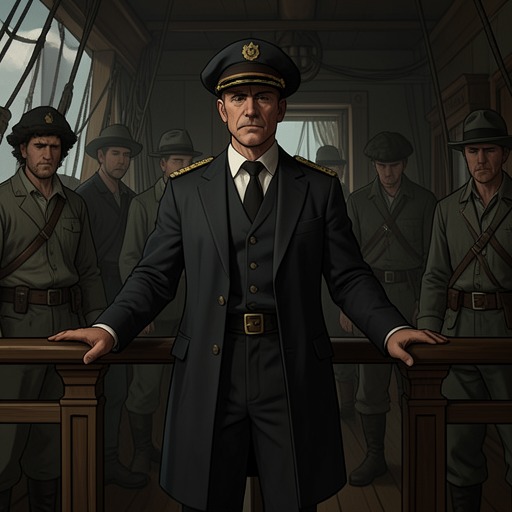
The Caine Mutiny Court-MartialLoyalty and obedience in the novel are not simple synonyms. The court-martial tests whether service means following every order, while Willie Keith’s testimony and later letter distinguish obedience from submission to what he regards as irrational persecution. His account of helping Steve Maryk get Stilwell home makes that distinction concrete; his later reassessment, however, recognizes that disloyalty toward Captain Queeg also deepened the shipboard crisis. The subject thus turns on a difficult question: how can an officer protect another person without undermining the command on which everyone depends?
The Court’s Test of Obedience
During the trial, Jack Challee turns Willie’s recollection of an earlier incident into a challenge to his understanding of naval loyalty. He asks whether Willie is saying that Maryk deliberately violated the captain’s orders as far back as December 1943. The question links an act that Willie presents as humane to the later removal of Queeg, inviting the court to see both as evidence of a settled pattern of insubordination. The apparent continuity matters: Willie and Maryk are not being asked only what they did, but whether they consider their own judgment a license to disregard command.
Willie answers that loyalty means obeying “All orders, except irrational persecution.” He does not describe the exception as unrestricted personal preference. When asked about recourse, he acknowledges that an officer can send a letter to higher authority through the captain. But he explains why that route did not answer the immediate need: “I had to sail with Queeg for another year. The important thing was to get Stilwell home.” In his account, formal complaint would have left Stilwell’s urgent situation unresolved while Willie remained under Queeg’s command. The contrast is between a remedy that might eventually address the order and an intervention intended to relieve a shipmate’s immediate hardship.
Challee also frames the earlier episode as a precedent for the later crisis, calling Willie, Maryk, and Stilwell an “insubordinate trio.” Willie resists the implication that the same group had conspired toward a common end. He says he and Stilwell happened to be on duty when Queeg broke down, and that another officer of the deck and helmsman would have acted as they did. His testimony therefore separates shared participation in an emergency from a prior plan to depose the captain. Yet the court’s juxtaposition exposes a genuine vulnerability in his defense: the December breach shows that he had already placed a concrete human need above an express order.
Stilwell and the Earlier Breach
Willie does not evade the substance of the earlier act. In December 1943, Queeg had denied Stilwell leave, and Maryk issued him a seventy-two-hour pass against the captain’s express instructions. Willie confirms that Maryk knew leave had been denied. When asked whether this was loyal, Maryk answers, “No. It was a disloyal act.” His admission is striking because he does not try to make the violation disappear by renaming it obedience to a higher principle. The act broke the command relationship even as Willie’s testimony presents its purpose as getting Stilwell home.
The incident also complicates any easy division between loyal officers and disloyal ones. Maryk could override Queeg’s order in Stilwell’s case, yet Willie says that Maryk never permitted criticism of the captain in his presence. When derogatory remarks arose in the wardroom, Maryk would leave; every other officer, Willie says, made such remarks. Maryk’s conduct holds together two positions that might seem contradictory: he could take direct action against an order he considered intolerable, while refusing to join the routine disparagement of the officer who issued it. In this account, disobedience did not necessarily mean contempt for the person or office of the commander.
Willie’s own defense is similarly practical rather than purely procedural. He admits that he would repeat the act under the same circumstances, and he tells the court that he could not afford to wait through another year aboard the ship while Stilwell remained in difficulty. That does not make the act authorized; Maryk’s testimony makes its disloyal character explicit. Instead, the two accounts leave the moral tension visible: the officers’ action could be compassionate in purpose and still be a direct violation of command.
From the Trial to Willie’s Reassessment
In his later letter, Willie revisits the trial and the events behind it from a changed perspective. He says that he is not in the brig because Maryk was acquitted and his own case was dropped. But legal outcome does not settle his moral account. He writes that the “mutiny” was mostly Keefer’s doing, while insisting that he and Maryk also bear substantial blame. He now sees that they had transferred to Queeg a hatred that should have been directed at the enemies who had torn them from the beach and kept them imprisoned aboard an old ship for years. Their disloyalty, in his retrospective judgment, made matters harder for Queeg and for themselves, drove Queeg toward his worst outrages, and contributed to his psychological collapse.
Willie also identifies how judgment about command became entangled with the law. He says Keefer put the idea of Article 184 into Maryk’s head, after which the rest of the horror followed. He does not claim to know whether the ship should have gone north or south in the typhoon, and says he never will know. But he concludes that Maryk did not have to relieve Queeg: Queeg might have turned north himself, or Maryk might have taken over while Queeg continued to follow after protesting. In this imagined alternative, the relief would not have led to a court-martial, and the ship would have remained in action rather than spending time in San Francisco during major operations of the war. These are Willie’s later counterfactuals, not facts the letter can resolve; their importance is that he now doubts the necessity of the act he once defended.
His revised principle is severe: when an incompetent captain is a chance of war, the crew should serve him as though he were the wisest and best, cover his mistakes, keep the ship going, and endure. The formulation sits uneasily beside his earlier exception for irrational persecution and his willingness to help Stilwell despite an explicit order. The letter does not erase those earlier choices. Rather, Willie reinterprets them within a broader responsibility to the ship and to the people forced to serve together. He attributes much of this changed understanding to Maryk’s defense counsel, Greenwald, and describes his movement toward old platitudes as part of growing up.
Loyalty as Shared Responsibility
The novel’s treatment of loyalty remains conflicted because neither literal obedience nor personal moral judgment guarantees a good result. Willie’s testimony treats the order denying Stilwell leave as an instance in which compliance would have prolonged a specific hardship. His later letter warns that opposition to Queeg, even when grounded in real frustration, became destructive when the officers redirected the anger of wartime confinement against their own commander. The two accounts do not cancel one another: the earlier act is still disloyal in Maryk’s own words, while the later recognition of collective responsibility does not prove that every order deserved unquestioning compliance.
Willie’s changed account is also a change in how he assigns blame. At trial, he defends Maryk’s conduct and distinguishes the emergency from any prior conspiracy. Afterwards, he includes himself in the disloyalty that helped intensify Queeg’s failures, while still recognizing Keefer’s role in directing Maryk toward Article 184. He can condemn the mutiny’s consequences without making Queeg a blameless commander: in the same letter, he calls both Queeg and Stilwell victims of war. Loyalty, as Willie finally understands it, is therefore not merely allegiance to an individual captain or a verdict about whether an order is valid. It carries responsibility for the atmosphere officers create, the mistakes they conceal or magnify, and the shipmates who must bear the consequences together.